
Opening the Channel to the Next Generation of Coastal Professionals
In collaboration with the Port of Port Arthur, Texas Sea Grant runs the Youth STEAM Workforce Education program, a two-part initiative that introduces high school students to the wide range of jobs available in the maritime industry and on local waterways.
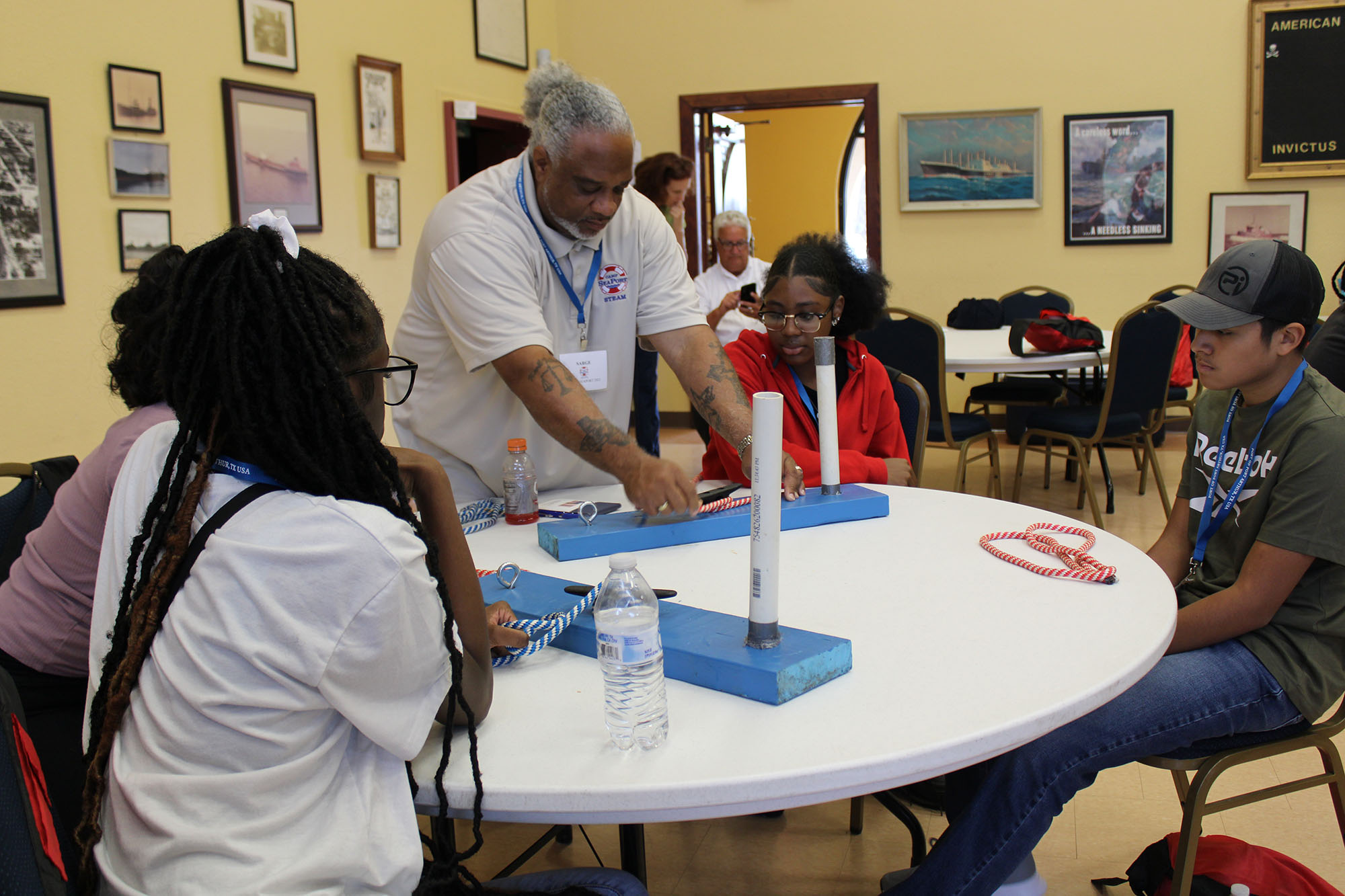
Port of Port Arthur, Camp Seaport
The rumble of a tugboat carries across the Port Arthur waterfront as a small group of teenagers steps onto the dock, clipboards in hand and lifejackets buckled tight. For many, it’s their first time this close to a working port and their first look at the careers that keep the Texas coast moving.
That kind of moment is what Nikki Fitzgerald, Texas Sea Grant and Texas A&M AgriLife Extension agent for Jefferson and Chambers counties, works all year to create.
“My job as a county extension agent is to be able to do whatever my county needs,” Fitzgerald said. “Whether that is working with our crawfish farmers, our shrimpermen, our oystermen, crabbermen, I’m always there to help.”
In 2008, Port of Port Arthur Commissioner Linda Turner Spears sketched the idea for Camp Seaport on a napkin. It was a simple drawing that sparked what would become a transformative youth program for the region. What began as a rough concept quickly grew into a fully realized initiative designed to introduce local students to the maritime industry.
In collaboration with the Port of Port Arthur, Texas Sea Grant runs the Youth STEAM Workforce Education program, a two-part initiative that introduces high school students to the wide range of jobs available in the maritime industry and on local waterways. Organized and facilitated by Texas Sea Grant staff for more than 15 years, the program combines classroom-based STEM learning with hands-on field experiences that connect students directly to the coastal workforce.
The summer component, Camp Seaport, is a free, five-day program hosted at the Port Arthur International Seafarers’ Center. Each July, local high school students step into the heart of a working port to see firsthand how the maritime industry keeps the Texas coast moving.
Over the course of the week, students rotate through hands-on learning experiences that highlight every aspect of port life. They practice navigation and knot-tying alongside mariners, learn how cargo moves safely and efficiently through the port, and hear directly from pilots, engineers, and ship crews about their daily work. Out on the water, students ride with the U.S. Coast Guard to see vessel operations up close, visit an environmental floating classroom on the Neches River to explore how healthy waterways support commerce, and board a Beaumont Reserve Fleet ship to discover the variety of careers that keep maritime operations running smoothly.
Each student leaves Camp Seaport with a deeper understanding of how science, technology, and teamwork power the maritime industry, and with a clearer sense of how their own future could fit into that world.
The experience continues in February with a multi-week indoor session where students conduct STEM-based activities, like building a kayak out of recycled corrugated board, to deepen their technical skills and understanding of maritime operations. Program evaluations show a marked increase in students’ awareness of maritime career opportunities and the pathways available to pursue them.
Building a Local Workforce
The program has also built strong local support: industry partners contribute more than $30,000 annually in donations that fund scholarships for camp alumni pursuing college degrees, workforce education programs, or military service. Graduates of the camp have returned to the community as longshoremen, political leaders, and members of the Coast Guard.
“Camp Seaport is our 501(c)(3) program hosted by the Port of Port Arthur,” explained Lachelle Edwards, the port’s Public Affairs and Communications Manager. “We give local high school students the opportunity to experience a free five-day camp surrounded by everything maritime. Through Texas Sea Grant, we have specialists come in and allow those students to experience STEM-related activities and workforce education.”
For the Port of Port Arthur, the camp is more than outreach—it’s a bridge to opportunity.
“The city of Port Arthur is an economically disadvantaged community,” Edwards said. “To give students this opportunity to be exposed to something that they may not have had the opportunity to do elsewhere is an opportunity that we do not take for granted. We’re very grateful for Texas Sea Grant and their partnership throughout the years.”
Learning that Lasts
Since Camp Seaport began in 2008, the program has connected hundreds of local students to maritime and coastal careers.
“The partnership through Texas Sea Grant and the Port of Port Arthur has sustained for the last 16 years, and we look forward to many more opportunities and many more years to come to continue impacting the lives of students,” Edwards said.
Fitzgerald’s broader extension work continues that mission year-round. She partners with emergency management teams on coastal resilience projects, supports local fishermen with safety and sustainability training, and engages volunteers in habitat restoration. Whether teaching, restoring marsh grass, or guiding a new generation of mariners, she embodies Sea Grant’s model of science in service to the community.