
Coastal partners respond to cold-stunned sea turtles in the Laguna Madre
A cold snap along the South Texas coast on Jan. 26-27 prompted a coordinated response from coastal scientists, conservation organizations and volunteers working to rescue cold-stunned sea turtles in the Laguna Madre.
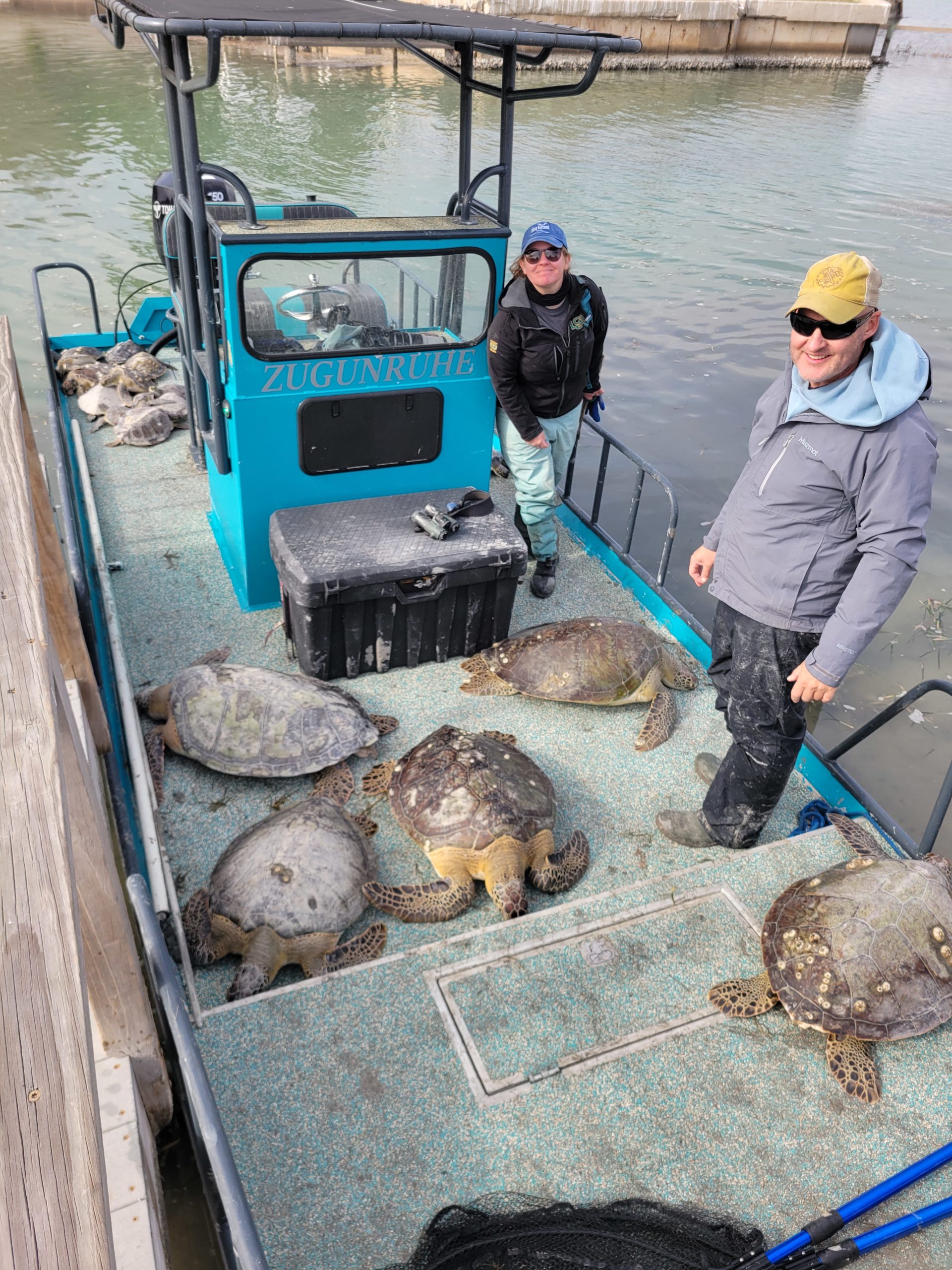 Stewart and LeClaire aboard boat assisting with the cold-stunned turtles.
 SOUTH PADRE ISLAND, Texas — A cold snap along the South Texas coast on Jan. 26-27 prompted a coordinated response from coastal scientists, conservation organizations and volunteers working to rescue cold-stunned sea turtles in the Laguna Madre.
Texas A&M AgriLife and Texas Sea Grant Coastal and Marine Extension Agent Sara Stewart, who serves Cameron County, joined partners from the Coastal Bend Bays & Estuaries Program and other agencies to locate and recover green sea turtles affected by the sudden drop in water temperature.
Sea turtles are cold-blooded reptiles, meaning their body temperature depends on surrounding water conditions. When temperatures fall below about 50 degrees Fahrenheit, turtles can become lethargic and lose their ability to swim normally.
While it may seem instinctive to return a stranded turtle to warmer water, experts advise against it. According to the National Oceanic and Atmospheric Administration, cold-stunned turtles require careful monitoring and a gradual rewarming process in a controlled environment. Rapid temperature changes can shock their systems and reduce their chances of survival, making transport to rehabilitation facilities critical.
“When sea temperatures drop that quickly, turtles can become cold-stunned,” Stewart said. “They lose the ability to swim well, so wind and tides can push them into shipping channels or wash them onto shore.”
Without rescue and rehabilitation, turtles may be unintentionally struck by passing boats or die after being stranded on land for prolonged periods.
Responding in the field
During the event, response teams searched the Laguna Madre by boat for turtles floating at the surface or stranded along muddy shorelines. The water was cold and quiet, with turtles floating lethargically at the surface, often mistaken at a distance for debris until boats drew closer.
Stewart assisted in rescuing 75 of the 342 turtles collected during the event, working alongside program staff and volunteers.
“It was a chilly day to be out on the water,” Stewart said. “When we find them floating, we gently scoop them up with dip nets or lift the larger turtles onto the boat by hand. Some of them can be extremely heavy — green sea turtles can weigh up to 350 pounds.”
Some rescues required responders to walk through deep mudflats to retrieve turtles that had washed ashore during changing tides.
“At one point, I was dropped off to start walking toward a stranded turtle a ways in on the mud flat, while the others took the boat across the channel to pick up turtles that were closer to the water,” Stewart said. “Once I made my way back to the water’s edge, I found myself standing in shallow mud and seagrass with a net for balance in one hand and a small sea turtle in the other. It was oddly serene given the circumstances.”
Rescued turtles were transported to rehabilitation partners such as Sea Turtle Inc., where they are gradually rewarmed and monitored before being released.
Partnerships support rapid response
Cold-stun rescue efforts rely heavily on coordination between agencies, nonprofit organizations and volunteers.
“Partnerships and volunteers are essential during cold-stun events,” Stewart said. “We can prepare when forecasts show temperatures dropping — coordinating volunteers, equipment and response locations ahead of time.”
Boat crews worked across the Laguna Madre while volunteers helped transport turtles to rehabilitation facilities. Stewart noted that much of this coordination happens before an event occurs through ongoing Extension work along the coast.
Many volunteers involved in these efforts are members of the Texas Master Naturalist program, a citizen science program that contributes thousands of hours each year to conservation efforts across the state.
“These volunteers play a huge role,” Stewart said. “Their volunteer hours are worth hundreds of thousands of dollars annually toward supporting Texas ecosystems.”
Connecting research and coastal communities
As a coastal and marine Extension agent with Texas Sea Grant and Texas A&M AgriLife Extension, Stewart focuses on building relationships between researchers, coastal communities and natural resource managers.
“Extension agents are like local liaisons within our fields,” Stewart said. “Research doesn’t do anyone any good sitting on a shelf — we find ways to get that information into communities and help people use it.”
Stewart said her role often involves linking researchers, resource managers, nonprofits and community members so they can work more effectively together.
“It’s about making sure the right people are connected before something happens,” she said.
Those connections are especially important when a cold snap occurs.
“When something like this happens, those relationships are already there,” Stewart said. “It allows everyone to organize quickly and work efficiently.”
Supporting healthy coastal ecosystems
Cold-stun response efforts support Texas Sea Grant’s Healthy Coastal Ecosystems focus area by protecting endangered marine species and supporting biodiversity in the Laguna Madre estuary.
“It protects an endangered and federally protected marine species and strengthens stewardship across agencies,” Stewart said. “Healthy ecosystems require long-term habitat management, and events like this bring awareness to coastal ecosystem dynamics.”
Stewart said the January event highlights the importance of planning and coordination for coastal resilience.
“Preparedness, communication networks and volunteers are vital components of responding to these events,” she said.
Reporting Sea Turtle Sightings
Stewart said public reporting plays a major role in protecting sea turtles along the Texas coast. Anyone who encounters a stranded or nesting sea turtle should immediately call the Texas State Sea Turtle Hotline at 1-866-TURTLE-5 (1-866-887-8535).
Beachgoers are encouraged to stay at least 50 feet away and avoid touching or disturbing the animal while waiting for trained responders to arrive. All sea turtles are federally and state protected, making it illegal to handle them without proper permits.
“Quick reporting helps response teams protect both the turtles and the public,” Stewart said.