
Training the Trainers: Preparing Jurisdictions for Comprehensive Hazard Recovery, Response and Resiliency
When disaster strikes, recovery begins long before the storm. Through a partnership with TEEX and TDEM, Texas Sea Grant’s resiliency team helps coastal leaders prepare for recovery with hands-on training in FEMA’s Public Assistance Program—strengthening collaboration, documentation, and long-term community resilience.
Texas Sea Grant
When disaster strikes, coastal cities rely on a network of public servants, including city planners, emergency managers, public works directors, utility supervisors and others, to lead recovery and guide their communities back to trusted stability.
But recovery doesn’t start after the storm. It begins long before, with preparation, communication and shared knowledge among those tasked with rebuilding systems.
Over the past few years, Texas Sea Grant’s resiliency team has worked to create a space for officials to engage in open discussions and better prepare for current and future recovery tasks facing their regions.
This effort has been realized through a series of courses initiated by the Texas A&M Engineering Extension Service (TEEX) in partnership with the Texas Division of Emergency Management (TDEM) and designed to connect stakeholders. Texas Sea Grant’s Coastal Resilience Specialist, Madgellen Cleary, played a key role in coordinating this year’s courses by connecting local jurisdictions, recruiting participants and ensuring coastal stakeholders were represented in the room.
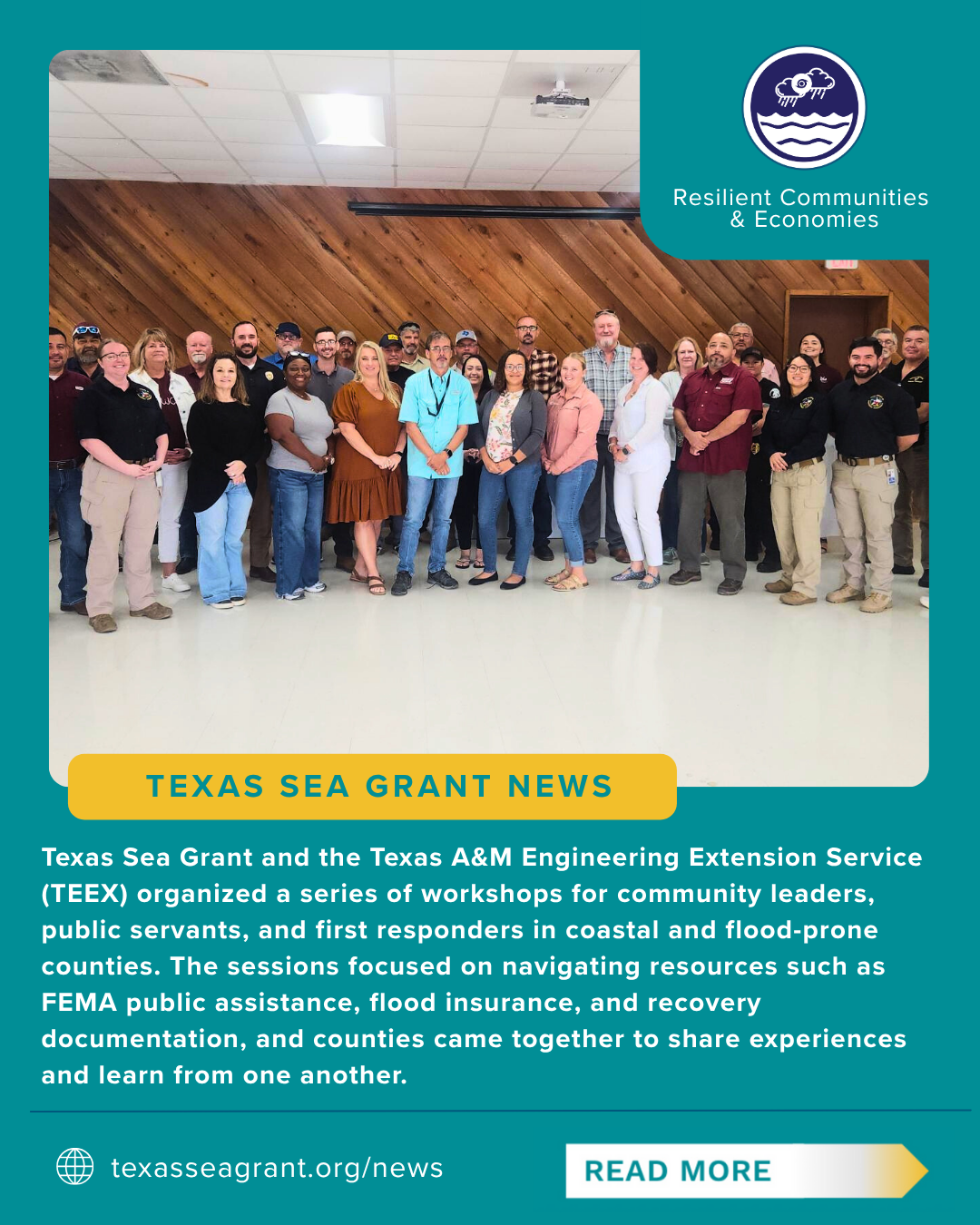
The most recent and capstone course in the five-part Infrastructure Disaster Management Certificate series, Disaster Recovery Public Assistance Programs: An Introduction (MGT-482), was held July 23–24, 2025, at the Calhoun County Agriculture Auditorium in Port Lavaca, a community often on the front lines of coastal hazards. The course brought together more than two dozen representatives from both coastal and inland communities, including city administrators, emergency management coordinators, public works directors, law enforcement and other public service leaders from Calhoun County and beyond.
Over two days, participants gained hands-on insight into the FEMA Public Assistance Program, which provides federal support for repairing and restoring public infrastructure such as roads, schools, bridges and emergency services facilities affected by natural disasters. TEEX’s Program Director for Disaster Management for Critical Infrastructure, Vince Salamski, and instructor Mike Gavin guided attendees through key topics, including the stages of the Public Assistance process, eligibility and costs, damage assessment and project formulation and federal procurement and contract compliance.
“Even before I helped organize this recovery class, I often heard from stakeholders that the recovery stage is the most overlooked part of disaster management because it can be so intensive,” said Cleary. “Recovery requires very specific documentation. For example, when constructing a bridge, or infrastructure for that matter, officials need to timestamp and geolocate every decision related to the project. That way, if anything happens, such as a flood, they have the proper documentation for a successful claim. It’s essentially like home insurance for the city.”
The training emphasized collaboration between applicants and agencies, pre-disaster planning, and strategies for managing recovery funds efficiently and equitably, ensuring communities can access resources when needed. Attendees also highlighted the importance of learning about thorough pre-disaster documentation, which many cited as particularly impactful in a post-course survey.
Cleary noted that the course created a space for officials to openly discuss complex or cumbersome topics, share experiences and establish connections so they don’t have to navigate these logistical processes alone.
“Understanding the required documentation, the reimbursement process and the policies that need to be in place now not only sets officials up for success, but also builds trust with their constituents, who can see their community being restored,” she explained.
For Texas Sea Grant, this partnership advances its mission to strengthen the resilience of coastal communities through science-based outreach and education. By organizing and promoting these trainings, Texas Sea Grant equips officials across coastal jurisdictions with the knowledge, tools and frameworks needed to respond to and recover from natural hazards, building resilience not just in ecosystems, but in the people who protect and lead them.
These courses are part of a recurring statewide initiative, with additional trainings planned in 2026 and beyond. Together, TEEX, TDEM and Texas Sea Grant are helping local leaders build long-term resilience of their communities.
####
About Texas Sea Grant
Texas Sea Grant is a unique partnership that unites the resources of the federal government, the State of Texas and universities across the state to create knowledge, tools, products and services that benefit the economy, the environment and the citizens of Texas. It is administered through the National Oceanic and Atmospheric Administration and is one of 34 university-based Sea Grant Programs around the country. Texas Sea Grant is a non-academic research center at Texas A&M University. The program’s mission is to improve the understanding, wise use and stewardship of Texas coastal and marine resources.
About Resilient Communities and Economies:
Texas Sea Grant strengthens the resilience of coastal communities and economies by providing expertise, tools, and education that help Texans prepare for, respond to, and recover from coastal hazards. Its work includes hazard preparedness training, risk and vulnerability assessments, disaster and recovery guidance, and assisting with coastal watershed planning and education. By supporting communities and decision-makers, Texas Sea Grant helps safeguard lives, livelihoods, and infrastructure while promoting sustainable economic and environmental resilience along the Texas coast. Learn more at Texasseagrant.org.