Texas Sea Grant’s Approach to Nature-Based Solutions
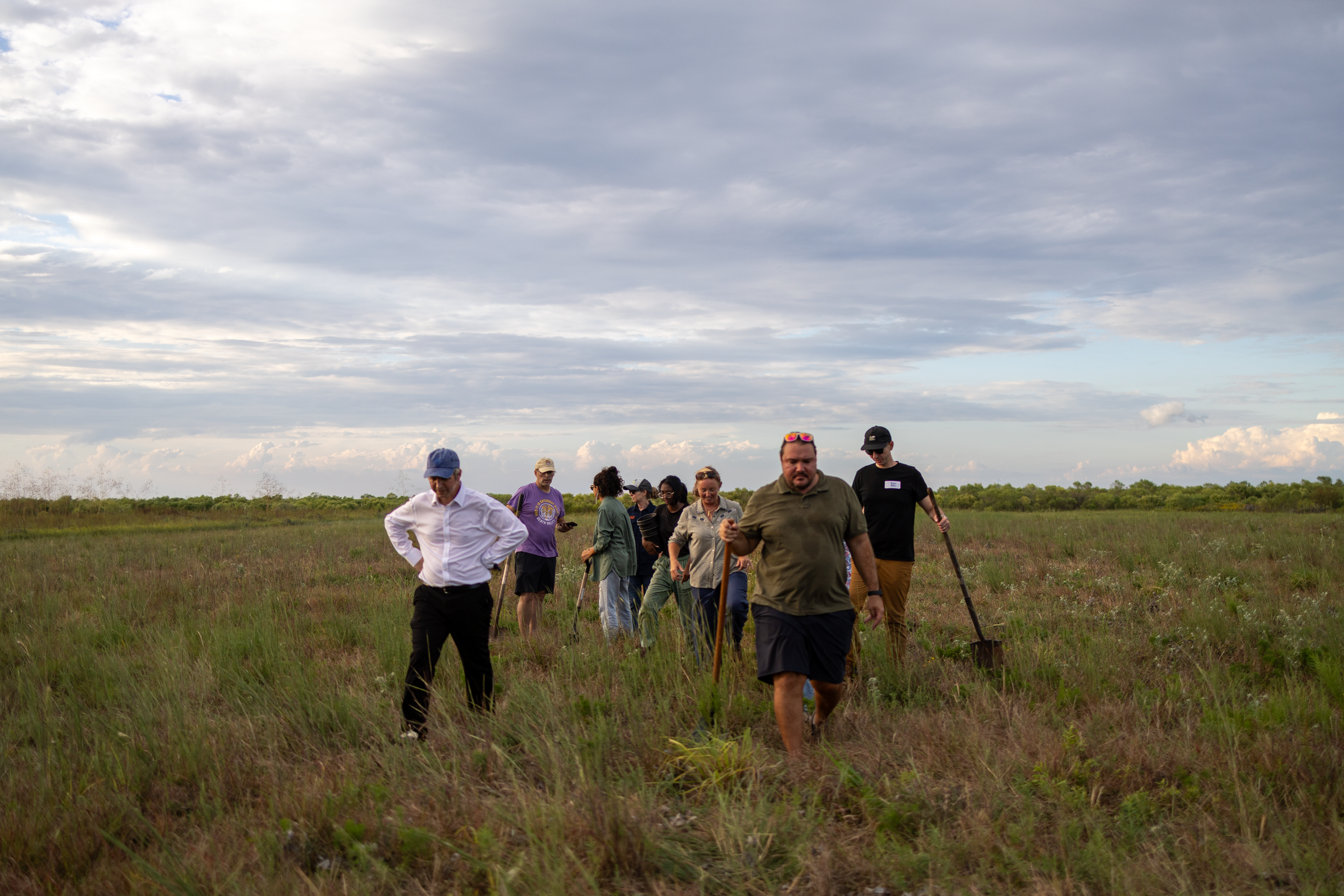 <em>Resilience practitioners volunteer with Artist Boat in Galveston to replenish native coastal prairie grasses as a nature-based solution for strengthening coastal resilience.</em>
What if the best tools for protecting the environment are already at our fingertips?
This idea is the foundation of nature-based solutions (NbS): approaches that use natural systems and eco-friendly design to improve infrastructure so we can live with the environment, not against it. Texas Sea Grant’s Resilient Communities and Economies (RCE) team is expanding its work in this area to support coastal resilience across Texas.
Defining Nature-based Solutions
NbS offer an alternative to relying only on traditional, built infrastructure to address challenges like flooding, runoff pollution, and habitat loss. By incorporating natural systems such as wetlands, dunes, and oyster reefs, they work with the environment to manage water, reduce pollution, and strengthen coastal resilience.
For example, along natural coastal areas introducing living shorelines, wetland restoration and dune restoration can absorb floodwaters, reduce storm surge, filter pollution, improve air quality, support wildlife and provide space for recreation. Unlike traditional infrastructure, which often serves a single purpose, NbS can address several challenges at once.
In more developed areas, NbS often takes the form of green infrastructure – a network of natural and semi-natural systems that manage stormwater and improve water quality. Common examples include rain gardens (shallow, planted areas that capture runoff), bioswales (vegetated channels that slow and filter water), and cisterns (systems that collect and store rainwater for reuse). Hybrid solutions combine these natural features with traditional engineering, such as stormwater detention ponds with native vegetation, permeable pavement paired with underground drainage, or oyster reefs reinforced with structural supports.
In more recent years, Texas Sea Grant, resilience partners, local officials and researchers have been exploring how to apply NbS to coastal communities, and more specifically, to the diverse environments along the Texas coast. Interest in NbS has grown as coastal hazards become more frequent and intense. At the same time, no two stretches of coastline face identical conditions. Barrier island communities contend with erosion and overwash, bayside towns experience flooding and saltwater intrusion, and estuarine regions must balance habitat loss with development pressures. These differences require tailored, place-based approaches rather than one-size-fits-all solutions.
As a result, communities are seeking adaptable strategies that not only address their specific risks but also reduce long-term costs while delivering multiple benefits. In many cases, these benefits translate into a strong return on investment. Often referred to as ecosystem services, natural systems provide measurable value, such as flood protection, water filtration and habitat support, while also strengthening fisheries, improving water quality and enhancing recreation. By working with natural processes instead of against them, NbS can reduce the need for costly infrastructure repairs and ongoing maintenance, while increasing resilience in ways that evolve alongside the coastline itself.
Implementation from a Tested Lens
As interest grows, it is important that communities understand how these approaches work in practice. One example can be seen in Refugio County, a rural community on the Mid-Texas Gulf Coast with approximately 7,000 residents facing challenges such as shoreline erosion, flooding and limited access to outdoor spaces.
In the study Co-developing Nature-based Solutions for Coastal Resilience: A Case Study from Refugio County, Texas, researchers worked with residents to identify local priorities. Through workshops, surveys and advisory groups, the community shaped a plan to address ecological challenges while supporting overall well-being.
One concept explored through the study was the Black Point Living Shoreline, designed to reduce erosion, restore wetland habitat and improve public access. The site experiences impacts from storm surge, wave energy and rising water levels, making it vulnerable to sea level rise. Planned in phases, the project includes shoreline stabilization, trails and boardwalks, and future habitat expansion using dredged material to support the nearby marsh.
This collaborative process, known as co-production, brings together scientists, decision-makers and community members to design solutions that reflect local needs. While many projects remain ongoing, and some face challenges such as funding and land access, this approach provides a replicable model for how rural communities can identify and address local issues.
Regional partnerships also help bring these concepts to life. The Coastal Bend Alliance for Sustainable Stormwater (CBASS), of which Texas Sea Grant is a member, introduces residents and decision-makers to NbS through hands-on learning and site tours.
For example, in Rockport, CBASS showcased a permeable paver installation at Memorial Park, where an aging parking lot frequently holds standing water. To improve drainage, partners from Doucet, a civil engineering and design services company, retrofit four parking spaces and nearby no-parking areas with just over 1,000 square feet of permeable pavers, which treat runoff from around 10,000 square feet of the surrounding area.
Unlike traditional pavement, which encourages stormwater and pollutants to flow downstream, permeable pavers allow water to filter through surface gaps and underlying aggregate layers before entering the storm sewer system. The installation is designed to remove up to 90% of total suspended solids, along with nutrients, bacteria and vehicle-related contaminants. Located in a highly visible public space, the project serves as a demonstration site to help residents and decision-makers better understand how green infrastructure can reduce flooding and improve water quality.
“The experiment demonstrated the drainage capacity of the permeable pavers at Memorial Park exceeds 90 inches of rain per hour,” said Nick Dornak, Water Strategies Lead at Doucet, a Kleinfelder Company. “With traditional pavement, water simply sheets off the surface during storm events, carrying pollutants with it. Permeable pavers help improve both drainage and water quality.”
Nature-based approaches are also gaining traction in floodplain and watershed planning. Through partnerships like Clean Coast Texas and workshops such as Green Infrastructure for Texas, communities are introduced to strategies like floodplain restoration and bioswales that absorb rainfall, reduce flooding and improve water quality. These efforts help bring NbS from concept to practice, giving communities a clearer understanding of how they can be applied locally.
Texas Sea Grant’s role and examples
Texas Sea Grant supports the growth of nature-based solutions through education, workforce development and outreach, helping translate ideas into real-world application.
Workforce Development
One example of Texas Sea Grant’s workforce development efforts was the Coastal Resilience and Adaptation Conference, which brought together researchers, practitioners and community members to explore hazard mitigation, emerging technologies and nature-based approaches to resilience. The 2024 virtual event included six sessions and 20 presentations focused on practical tools for coastal communities.
The conference was developed as part of a Texas Sea Grant-funded project aimed at increasing awareness of advanced technologies that support coastal adaptation, including tools for energy transition, early warning systems and nature-based solutions. A key goal was to provide communities with practical, science-based information they can use to strengthen resilience efforts.
Beyond industry engagement, Texas Sea Grant also supports workforce development through university instruction and professional training. As part of coursework at Texas A&M University at Galveston, Texas Sea Grant Extension Lead and Associate Director Chris Hale has delivered lectures on stakeholder engagement in nature-based solutions, engaging professionals such as engineers, consultants, and state agency staff who are working in, or looking to build expertise in, this space.
Internationally, TXSG Coastal Resilience Specialist Madgellen Cleary has helped lead efforts through the German American Nature-Based Solutions Exchange. In 2023 and 2025, more than 60 participants from around the world visited the Texas coast for field tours and research exchanges, exploring projects like coastal prairie restoration at the UH Coastal Center and sargassum dune restoration at East Beach in Galveston.
Environmental Literacy and Youth Engagement
Texas Sea Grant brings these concepts directly to communities through hands-on outreach. Tools like a floodplain model demonstrate how different landscapes respond to flooding – showing greater damage in traditionally built environments like parking lots, reduced impacts with nature-based solutions like retention ponds and the least damage when natural systems such as wetlands are preserved. These demonstrations also highlight nonpoint source pollution, a major issue along the Texas coast and one of the major areas of focus for Clean Coast Texas.
Another example is the “bioswale in a bag,” developed by Vision Galveston, which shows how green infrastructure can absorb stormwater in flood-prone areas. These systems can be applied in parks, neighborhoods, medians and along streets known as “curb cuts” to reduce flooding and improve water quality.
Aggies Invent Junior, a Texas A&M Engineering Spark! initiative brought to the Texas coast in partnership with Texas Sea Grant, challenges students to develop solutions to real-world coastal issues. Texas Sea Grant worked alongside Engineering Spark! to coordinate the event locally, partnering with schools, organizing the venue, recruiting sponsors and judges, and developing coastal challenge topics relevant to the region.
In one session in Matagorda County, 25 students worked in teams to address issues such as stormwater management and marine debris. Guided by engineers and marine professionals, they built prototypes and presented their ideas, gaining both technical and communication skills. Many of the solutions reflected nature-based thinking. One team designed an alligator-shaped robot to collect plastics before they reach bays and oceans, while another proposed a community “aqua park” that captures runoff and supports native habitat. These projects highlight how the next generation is beginning to apply both natural and engineered solutions in creative ways.
“I was amazed at how the students took local challenges and creatively engineered NbS through the Aggie Invent Junior workshop. Their ideas were innovative, thoughtful, and truly outside the box – especially the marine debris-vacuuming alligator! It’s exactly the kind of thinking our coast needs, ” said Amy Nowlin
NbS is not a one-size-fits-all approach. Successful projects must be tailored to local ecosystems, community priorities, and available funding, often requiring collaboration between scientists, engineers, policymakers, and residents.
For Texas Sea Grant’s resilience team, this work is a growing focus. While NbS do not replace traditional infrastructure entirely, they offer an important shift in thinking, one that recognizes the value of working with natural systems. Current projects and partnerships are early steps toward expanding efforts in areas such as living shoreline planning, floodplain restoration, coastal wetland resilience and green stormwater infrastructure.
But, it is true to say that in many cases, the lasting solutions come from strengthening the very environments that already shape the coast.
####
About Texas Sea Grant
Texas Sea Grant is a unique partnership that unites the resources of the federal government, the State of Texas, universities, and communities across the state to create knowledge, tools, products, and services that benefit the economy, the environment, and the citizens of Texas. It is administered through the National Oceanic and Atmospheric Administration and is one of 34 university-based Sea Grant Programs across the nation. Texas Sea Grant is a non-academic research and extension program at Texas A&M University. The program’s mission is to improve the understanding, wise use, and stewardship of Texas coastal and marine resources.
