
Community Engaged Intern Explores Coastal Science and Service
The Texas Sea Grant Community Engaged Internship gave Adam Guillen hands-on experience in oyster habitat monitoring, coastal resilience, and marine outreach. Inspired by his roots near South Padre Island, he now plans to pursue a career in restoring and protecting Texas coastal ecosystems.
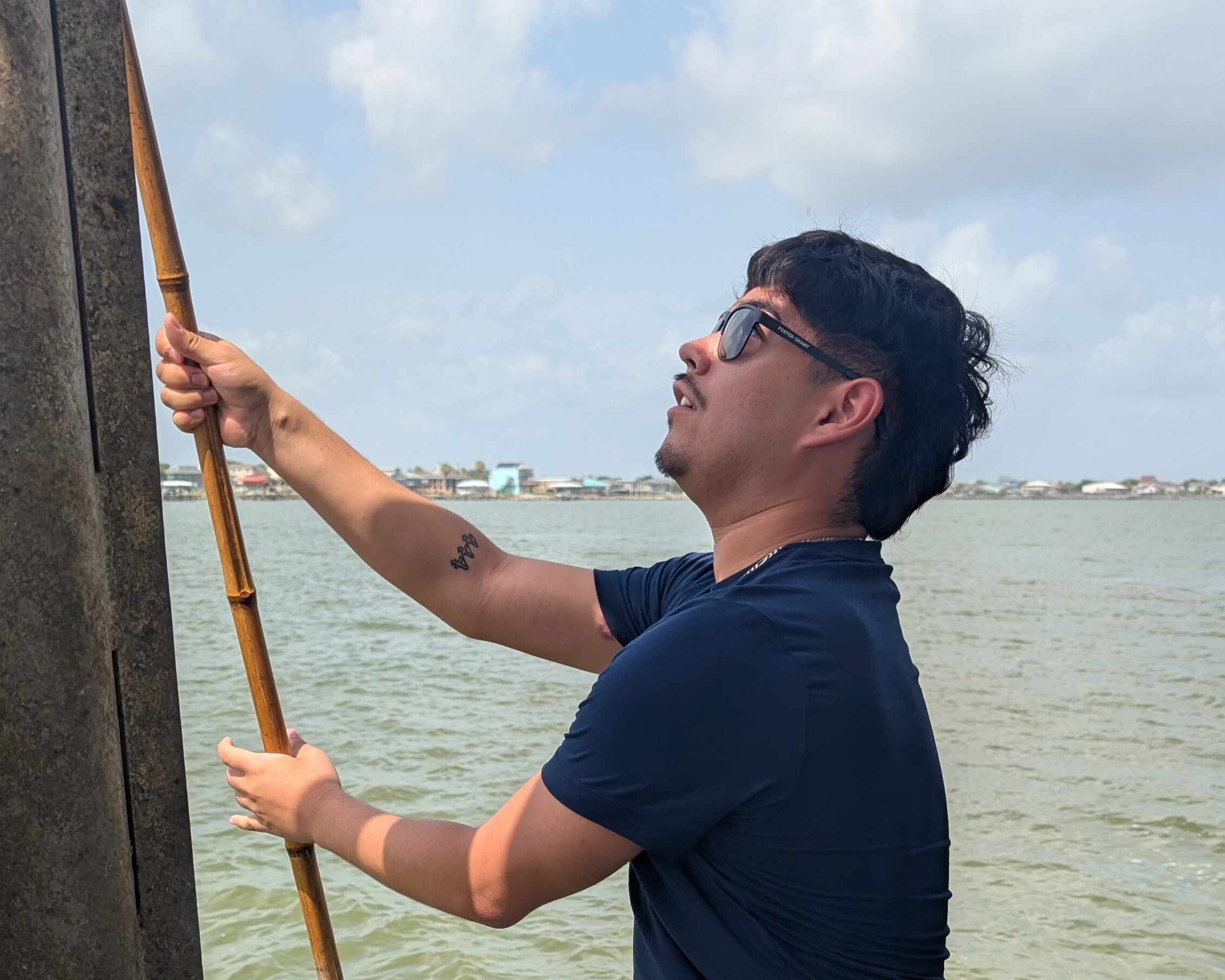 Adam measuring environmental conditions and conducting field sampling.
The Texas Sea Grant Community Engaged Internship (CEI) program offers undergraduate students from various areas of study the opportunity to gain hands-on experience in coastal and marine science, outreach and community engagement. Designed to foster the next generation of ocean and coastal leaders, the program pairs students with mentors on projects that support healthy coastal ecosystems, resilient communities, sustainable fisheries and environmental literacy.
This summer, Adam Guillen, a student from the Rio Grande Valley, joined the CEI program and spent several weeks immersed in real-world work that combined science, service and meaningful connections along the Texas Coast.
“Growing up close to South Padre Island, I grew a greater appreciation for protecting and restoring our Texas beaches and the Gulf after natural and man-made disasters,” Guillen said. “After graduating from college, I plan to focus on coastal resilience and restoration in the aftermath of both natural and human-caused disasters.”
His main project focused on oyster harvesting and habitat monitoring, a field experience that offered his first hands-on opportunity to work directly in coastal environments. On a typical day, Guillen helped assess oyster reef health by measuring environmental conditions and conducting field sampling.
“As we approach the quadrants where the reefs are located, we check the salinity, pH, turbidity, dissolved oxygen, wind speed/direction and temperature,” he said. “After that is done, using a long bamboo stick, we pick along the floor to check for reef, hard bottom, mud and sand. We take about 5-10 second intervals for each pick and record what the stick is coming in contact with.”
Guillen and his team logged their findings into an interactive GIS map to track progress over time. They also dredged the seafloor to assess oyster growth and health. “We record if the oysters are alive, new signs of spat, and their size,” he said. “Other oyster farms are used as living shorelines to build coastal resilience against natural disasters.”
While the oyster project was his focus, Guillen was exposed to a range of coastal issues and solutions. “My main project focused on oyster harvesting, but I have also had the opportunity to participate and learn about sustainable commercial and recreational fishing practices and outreach, marine debris prevention, affordable artificial intelligence (AI) water sensors, and green infrastructure,” he said.
Each new experience gave him a deeper understanding of the Sea Grant network and its mission. “All these outreach events and projects gave me the ability to expand my skill set and explore other ocean-related careers to which I had not yet been exposed,” Guillen said.
One of the most eye-opening parts of the internship, he said, was discovering how far-reaching the Sea Grant community really is.
“I was most surprised by the vast size of the Sea Grant network,” he said. “I had the chance to get to know other students and mentors and learn more about the project they are working on. Although my main focus will be the Gulf of America, it’s empowering to know that similar outreach and research efforts are happening in other coastal communities, and it motivates me to do the same for my local community.”
As he looks ahead, Guillen said the internship gave him the tools and confidence to pursue a career in coastal restoration and resilience.
“I believe that completing my internship with Texas Sea Grant will leave me with a more diverse skill set and a clearer path as I transition from school to the workforce,” he said. “Taking all this into account, I am appreciative of all the learning experiences Texas Sea Grant has provided me, and this internship has directed me to the right path that will lead me to a successful future.”
####
About Texas Sea Grant
Texas Sea Grant is a unique partnership that unites the resources of the federal government, the State of Texas and universities across the state to create knowledge, tools, products and services that benefit the economy, the environment and the citizens of Texas. It is administered through the National Oceanic and Atmospheric Administration and is one of 34 university-based Sea Grant Programs around the country. Texas Sea Grant is a non-academic research center at Texas A&M University. The program’s mission is to improve the understanding, wise use and stewardship of Texas coastal and marine resources.