
Where Are They Now?: The Fellow who Followed the Tides, Ellen Bartow-Gillies
For our first feature, we caught up with our first Coastal Management Fellow, Ellen Bartow-Gillies, to see how the fellowship launched her into a thriving federal coastal policy career and to explore the early interests that guided her path.
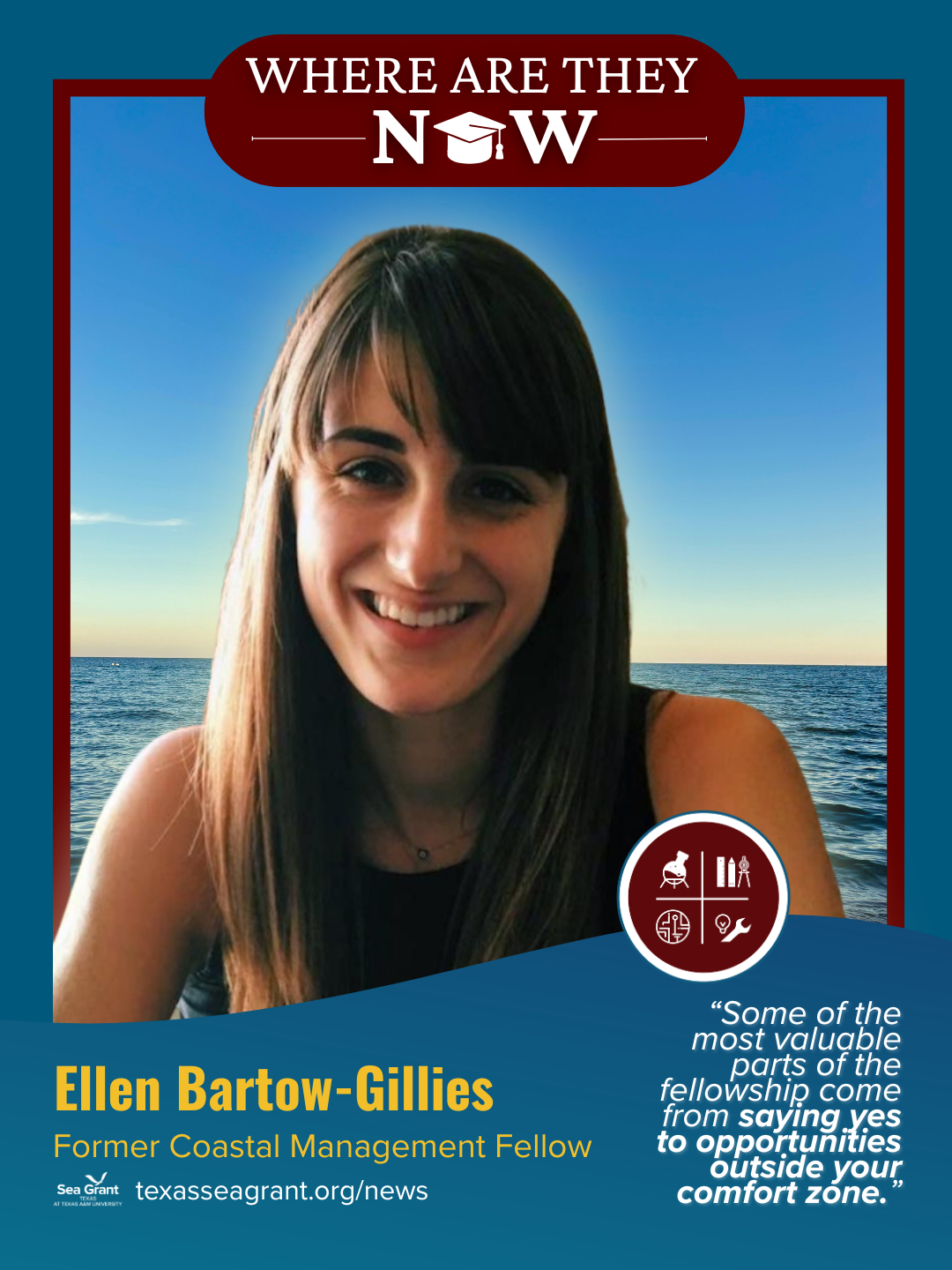
Ellen Bartow-Gillies
Texas Sea Grant offers fellowships and internships that give early-career scientists and students hands-on experience in research, policy and community engagement, launching them into careers in the coastal field.
In our new “Where Are They Now” series, we reconnect with former Texas Sea Grant students to explore how their experiences shaped their careers today.
For our first feature, we caught up with our first Coastal Management Fellow, Ellen Bartow-Gillies, to see how the fellowship launched her into a thriving federal coastal policy career and to explore the early interests that guided her path. Although she is not currently working in a coastal field, she shares how this early experience gave her the vital skills to pursue a career as a public servant in science communication.
Following the Tides
When the coast calls, curiosity follows. Raised in landlocked Kentucky, Bartow-Gillies was fortunate to spend her summers road-tripping to the Gulf with her family. “That’s where I first fell in love with the ocean,” Bartown-Gillies said. Those early moments stayed with her, eventually guiding her academic direction.
College took her to Tulane University, where she studied environmental science and economics. New Orleans, with all its charm, also carries the realities of coastal living. Within her first week as a freshman, Hurricane Isaac hit, giving her a crash course in the environmental issues she would later build a career around. Her coursework introduced her to topics such as sea level rise, coastal erosion, storm surge and land subsidence, but it was the stories of local residents that pushed her curiosity further. “Living in southern Louisiana was the most powerful coastal science teacher I could have asked for,” Ellen said. “It planted in me the desire to explore this challenge down the road.”
That desire eventually led her to the Sea Grant Coastal Management Fellowship, a program that pairs early-career scientists and policy-driven graduates with state coastal agencies for immersive, two-year positions. Designed to bridge academic training with real-world management, the fellowship allows participants to take on complex challenges alongside experienced mentors.
With encouragement from her graduate advisor, Dr. Brendan Roark at Texas A&M University, Ellen applied and became Texas Sea Grant’s first recipient of the fellowship in 2018.
“One of the most rewarding aspects of my work is bringing research to policy—ensuring that rigorous science directly informs conservation actions and decision-making. But, connecting students with opportunities to engage in both research and policy efforts is even more meaningful to me,” said Dr. Roark.
“Ellen distinguished herself as an outstanding student by developing a unique combination of scientific expertise and socio-economic insight. Her strong academic abilities, alongside her ability to navigate both research and policy landscapes, made her an exceptional candidate for the fellowship—a prestigious, nationally recognized honor. I was proud to support Ellen in her application, though it was ultimately her dedication and hard work that earned her this achievement.”
Her placement took her to the Maine Coastal Program at the Department of Marine Resources in Boothbay Harbor, where she focused on coastal restoration. More specifically, what happens when coastal wetlands are bisected by roadways and tidal exchange is disrupted.
To understand the coastal challenges unique to Maine, Ellen needed to build familiarity with the region’s tidal dynamics. Coming from Texas and Louisiana, where tides are often less than a meter, the Gulf of Maine was a dramatic shift. “The tides in the Gulf of Maine are some of the largest on the planet,” she said. The fellowship gave her room early on to learn, adapt and work with her mentors to shape the projects she would eventually lead.
This work culminated in the Tidal Restriction Atlas for Maine, an online tool identifying hazardous or restrictive culverts (a drain, channel, or pipe that runs under a road, railway, or other embankment to allow water to flow underneath), bridges and dams. The atlas informs communities, road owners and conservation groups about crossings that both threaten and support tidal system health, which is vital for storm protection, water quality, wildlife habitat and community use. Building off of this, she also collaborated with the CoastWise Steering Committee, a group that develops standards of best practice for tidal roadways, to publish a regional guidebook on safe, climate-resilient crossings and assist with installing marsh monitoring stations across the state.
Through this work, one of the biggest takeaways was the practical skills learned through communicating to different fields, especially in a community where the health of the tides matters so much to those who live nearby. “Scientists, policymakers and community members understand things differently,” Ellen said, “as a fellow, I led efforts to distill important research findings and differentiate outreach strategies based on the intended audience.” She noted that without effective communication, the project’s goals, timelines and impact would have been impossible to achieve.
Where She Is Now?
Those lessons carried Ellen into the next chapter of her career: science communication. After completing the Coastal Management Fellowship, she transitioned into federal science communication roles, and says that the writing, communication and public affairs skills gained in the fellowship allowed her to “springboard into a career of science communication at multiple federal agencies.”
She began at the National Snow and Ice Data Center (NSIDC) in Colorado as a Science and Technical Writer, translating complex climate and cryosphere research into clear, accessible publications. She then moved to NOAA’s National Centers for Environmental Information (NCEI) as a Physical Scientist, contributing to climate reports and working closely with experts across disciplines to ensure scientific accuracy and clarity.
Today, Ellen serves as a National Publications Editor for the United States Forest Service, where she helps refine scientific manuscripts and ensure research is communicated effectively across the agency and to the public.
Ellen believes the Coastal Management Fellowship prepares participants for leadership by placing them at the intersection of multiple interests and perspectives. “Working with stakeholders who can be deeply and emotionally invested in the future of their communities requires diplomacy, empathy and steady communication,” she said. The fellowship also pushes participants to communicate across formats, from reports to outreach booths to casual conversations. “Combined, these experiences build the confidence, judgment and versatility needed to lead in a complex, stakeholder-driven field.”
For future fellows, Ellen offers the advice, “be open to experiences that feel new or intimidating,” she said. “Some of the most valuable parts of the experience come from saying yes to opportunities outside your comfort zone. You may discover a niche you genuinely enjoy.”
And though her work now focuses on forests rather than coastlines, the imprint of her fellowship remains. “I do value my experience in the [coastal and marine field] and frequently work on projects that draw upon my knowledge or skills gained in my fellowship,” Ellen said. “And, I love surprising people with my in-depth knowledge of culverts.”
####
About Texas Sea Grant
Texas Sea Grant is a unique partnership that unites the resources of the federal government, the State of Texas, universities, and communities across the state to create knowledge, tools, products, and services that benefit the economy, the environment, and the citizens of Texas. It is administered through the National Oceanic and Atmospheric Administration and is one of 34 university-based Sea Grant Programs across the nation. Texas Sea Grant is a non-academic research and extension program at Texas A&M University. The program’s mission is to improve the understanding, wise use, and stewardship of Texas coastal and marine resources.