
Siblings of the Shore: The Depths of Texas Oyster Genetics
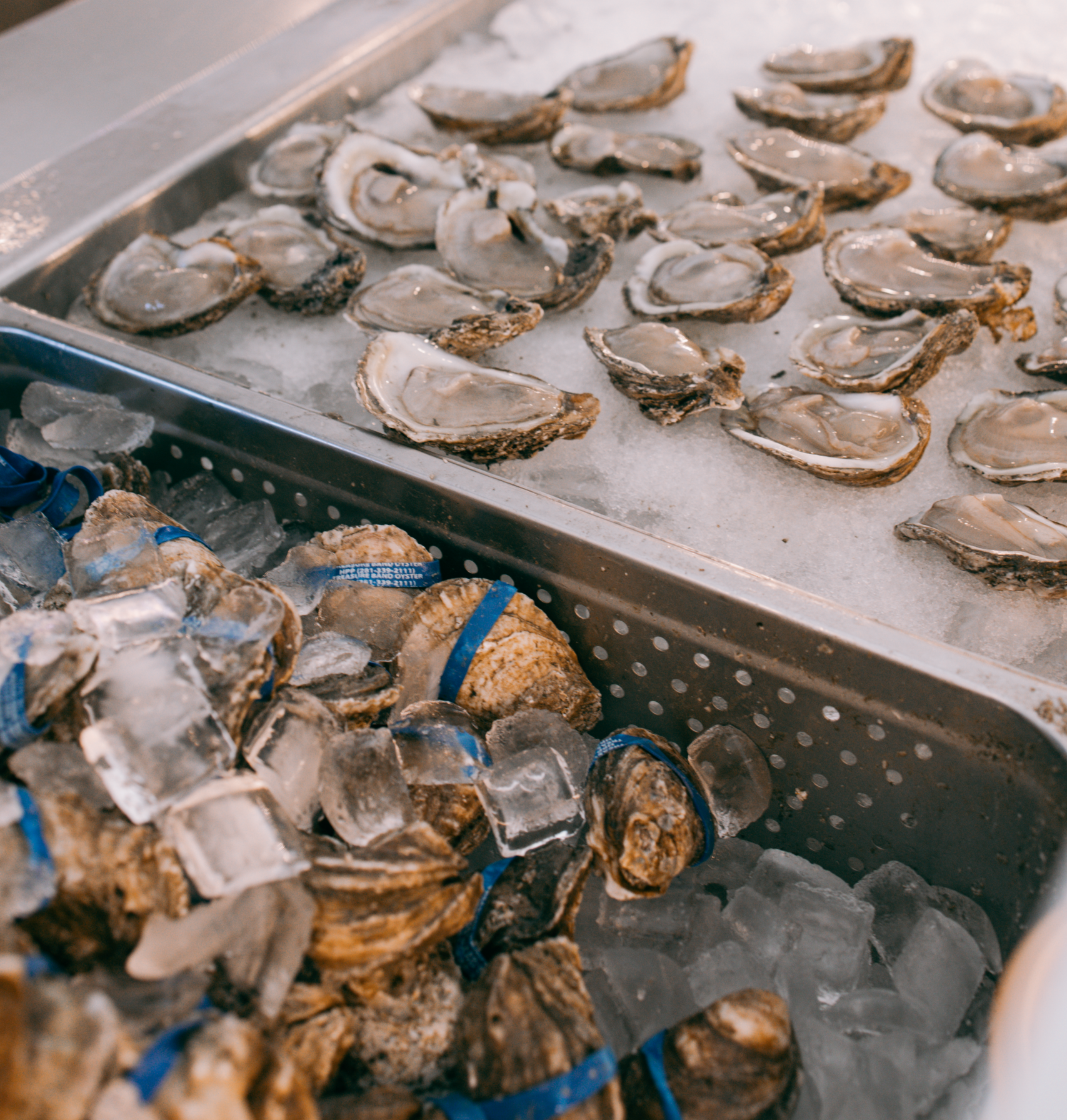 Oysters at Prestige Oyster, Inc. ready to be served from the shucking bar.
Along the shallow bays of the Texas coast, oyster reefs rise quietly from the mud and shell, forming living structures that stabilize sediments, filter water, and provide habitat for fish, crabs, and other estuarine wildlife. These reefs face extreme environmental swings, including sharp changes in salinity and temperature, as well as storms that sweep across the coast.
Understanding how oysters respond to these pressures is at the heart of a 2022 Texas Sea Grant–funded project led by geneticist Dr. Christopher Hollenbeck of Texas A&M University–Corpus Christi and Texas A&M AgriLife Research. His work is revealing how oyster genetics can guide restoration and support resilient coastal ecosystems.
The project focused on three objectives: developing cost-effective genetic tools, mapping the transition zone, and understanding physiological tolerances.
“Our research into population structure of oysters in Texas has built upon several studies that have indicated genetic differences in oysters along the coast (notably Anderson et al., 2014), specifically that there are two populations (in the north and south of the coast) that overlap to some extent in the Corpus Christi/Aransas Bay systems,” Hollenbeck said.“Recently, we’ve been able to add to this work, in collaboration with the Texas Parks and Wildlife Department (TPWD), by utilizing newer technology that allows us to observe differences at the genomic level. Not only does this provide higher resolution, but also gives us a way to understand how the genetic differences lead to differences in the physical characteristics of the populations.”
Hollenbeck’s research shows that the northern and southern oyster populations differ in environmental tolerances and spawning behavior. His lab’s work has built on studies that have shown that the southern population, adapted to the warm and hypersaline conditions of the Laguna Madre, is more resilient to changes in salinity, temperature, and dissolved oxygen. Although C. virginica ranges from New England’s Atlantic coast all the way down through the Gulf of America (formerly Gulf of Mexico), genetic analysis reveals a distinct, southern-Texas Gulf population in the western Gulf, highlighting how unusual this population break is within a broadly distributed species. Where they overlap near Corpus Christi, a dynamic transition zone is present that is important to consider for management and restoration decisions. Hollenbeck noted that the transition zone between the northern and southern populations appears to shift north or south over time, suggesting that population locations may change with cycles of environmental conditions, a factor important for management.
By tracking these shifts, scientists hope to anticipate how populations may respond to environmental changes and guide restoration and aquaculture strategies that maintain genetic diversity and resilience.
Hollenbeck’s work also revealed important implications for oyster reproduction. His studies of wild and domesticated oysters indicate that strong natural barriers prevent the northern and southern populations from mixing freely, and hybrids tend to have limited reproductive success. He emphasized that the genomic tools his team has developed make it possible to quickly and inexpensively determine the genetic background of individual oysters, allowing researchers to regularly monitor wild populations for changes or impacts.
Sustainability and Resilience Considerations
These tools are already influencing reef restoration, aquaculture, and fisheries management. Fine-scale genetic mapping helps agencies like TPWD and partner groups set broodstock guidelines that maintain genetic diversity and local adaptation, preserving traits that improve survival and resilience. Hollenbeck said the project’s findings are now being applied to match hatchery broodstock with the genetic background of wild locations for specific reef restoration projects in the transition zone.
For oyster aquaculture, studies of wild populations have been key to establishing sustainable breeding programs. The team has developed domesticated breeding lines sourced from both northern and southern populations, allowing farmers to grow seed that is locally adapted but also selectively bred for traits such as growth, shape, and salinity tolerance. Over time, these efforts are expected to provide farmers with a variety of seed options, reducing the risk of losing crops to environmental stress or disease.
Dr. Hollenbeck will continue to expand his work as the first inaugural Director of a new Texas A&M Center for Marine Aquaculture in Corpus Christi. Recently approved by The Texas A&M University System Board of Regents, the new marine aquaculture center at Texas A&M–Corpus Christi will unite research, training, and industry expertise to advance sustainable aquaculture practices, support coastal conservation, and strengthen agriculture along the Texas coast.
For Hollenbeck, the promise of oyster genetics is about building a sustainable future. “The more we learn about the genetic makeup of these oysters,” he said, “the better we can protect their diversity, their resilience, and their role in keeping our coastal ecosystems healthy.”
References
Anderson, J.D., Karel, W.J., Mace, C.E., Bartram, B.L., & Hare, M.P. (2014). Spatial genetic features of eastern oysters (Crassostrea virginica Gmelin) in the Gulf of Mexico: Northward movement of a secondary contact zone. Ecology and Evolution, 4, 1671–1685. https://doi.org/10.1002/ece3.1064
####
Texas Sea Grant is a unique partnership that unites the resources of the federal government, the state of Texas, universities and communities across the state to create knowledge, tools, products and services that benefit the economy, the environment and the citizens of Texas. It is administered through the National Oceanic and Atmospheric Administration and is one of 34 university-based Sea Grant programs across the nation. Texas Sea Grant is a non-academic research and extension center at Texas A&M University. The program’s mission is to improve the understanding, wise use and stewardship of Texas coastal and marine resources.